The overall performance of the fine wine market during the first half of 2024 can be summarised as resilient. Geographic differences highlighted in price movements, especially prices softening within Burgundy, have proved to be as much of an opportunity as a concern for many.
Something to remember when digesting this report: Fine wine has thrown up some amazing short and mid-term gains for clients, but the real wins come from a longer-term approach. The key elements that drive the market only increase the likelihood of longer-term holds being well rewarded.
In a recent discussion with a prominent Californian wine maker, conversation turned to the inelastic supply of wines that we work with and how the ‘luxury goods’ element has such a growing influence within the market. During the chat, he mentioned a statistic that although didn’t surprise me, did resonate and stick with me a while after; Upon a visit to Porsche, my esteemed associate was informed “For every 18 people who can afford a Porsche, we make 1”. Best results come when you have a demand that’s outstripping the supply. There are few markets where this can genuinely and exponentially increase as time goes by. Fine wine offers a truly diminishing supply of any given vintage with a growing audience of not only collectors but also casual investors and wine lovers. When making your assessment you must take into account the big picture and remember bravery in times of uncertainty or instability has often been rewarded.
Where this bravery is perhaps most clearly exemplified is in those who bought Sassicaia 1985. On release, in today’s money, this wine would have cost €9.00 per bottle, with a current average bottle price of over €3,450 per bottle, equating to growth of over 38,000%. When looking at the graph below, the eye-watering performance of the wine is obvious in the years after it’s release. But, without the privilege of hindsight, one has to wonder, what would I have done holding a case during this manic period of growth? The importance of the experience and guidance from a data and knowledge-driven company such as CB Wine cannot be understated when negotiating these times of volatility in a market than generally offers steady returns. It is with a market-literate portfolio manager by your side that the greatest returns achieved.
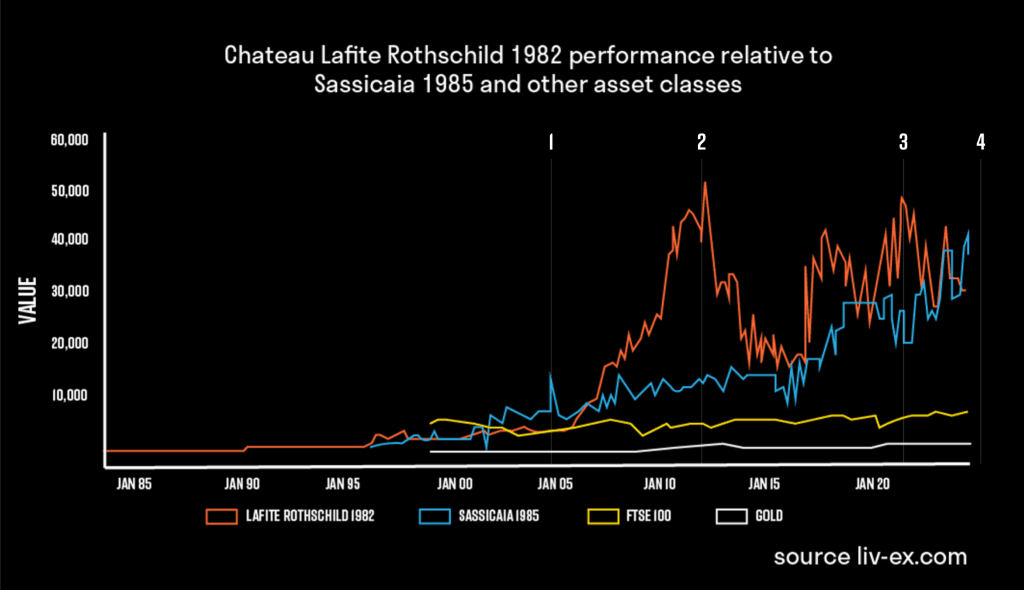
- Would you have been happy with your returns at this point in Sassicaia’s lifecycle?
- Compared to Lafite’s steep growth, how many brokers would have convinced their clients to sell Sassicaia here for underperformance?
- Experiencing growth followed by a dip, would you have been brave enough to hold and experience further uplift?
- What’s next for Sassicaia?
In any industry, companies’ efforts to gain interest from potential clients can unfortunately sometimes result in the use of hollow statistics and half-presented information. In our H1 report, we aim to give readers the broadest view of the happenings of the fine wine market, breaking down the timeline of performance in order to pass the confidence we have in this alternate asset investment over to our clients.
YTD 2024 Summary
January
- The Knight Frank Wealth Report and Luxury Investment Index reported seeing the robust performance of Fine Wine & Classic cars as the key drivers behind the solid historical performance of the KFLII.1
- The Italian index ‘Italy 100’ showed growth of 0.4% MOM, confirming the continued interest in a broad selection of Italian wines.
- Champagne slowed in 2023 after a great 2021/22; However, rare vintage Champagne remained the focus for many buyers in the secondary market.
- Domaines Barons de Rothschild, whose Bordeaux estates include Lafite Rothschild, Duhart-Milon and L’Evangile, acquired William Fèvre from Artémis Domaines.
February
- CB Wine conducted a full review of client stock undertaken, categorising each wine within our new 3-layer tier system: ‘Liquidity’, ‘Store of Value’, or ‘Legacy’, each with its own graphic symbol for easy identification. Each tier of this catalogue will have defined exit strategies. This distinction between wines will help our clients to better understand expectation and life cycle of any given recommendation **(see below for a tier system breakdown).
- 2019 Brunello di Montalcino released, with a quality that is already lauded by many.
- Continued interest in aged Bordeaux due to proven track record as a safe ‘store of value’ within the market.
March
- Signs of optimism within Italy and Champagne as the ‘Champagne 50’ index increases for the first time since late 2022.
- Fine wine positioned as a ‘Bear market’; General sentiment is positive with many clients having seen their patience rewarded for being brave and fighting their human nature in previous downturns, with an averaging down and leaning towards leaders within each region, peppered with a heightened interest in ‘high risk’ new producers within California.
- Liv-ex reports first positive movement of their benchmark index the ‘Liv-ex Fine Wine 100’ in twelve months, rising by 0.4%.
April
- The Asia market continued to be impacted by the Chinese economy; However, due to other Greater Asia countries’ increased demand, the region in general seems to have stabilised.
- CB Wine conducts a review of critics’ 2014 vintage 10-year retrospective, focusing on ‘best value’ offers.
- Screaming Eagle 2021 becomes most traded wine by value of Q1, bolstering the potential value of previous vintages as demand clearly continues to grow.
May
- Burgundy, based on Liv-ex data, officially becomes bear market. The 20% drop from its peak alerted many investors to a buying opportunity, with request for allocations within the region up 14% MOM.
- CB Wine marketing focus again turns to the US as the dollar strength provides buyers with excellent opportunities. A focus was placed onto existing domestic clients’ stock offers, providing exciting potential returns for them and for new buyers.
- Eyes on Bordeaux En Premier; We take a back seat as prices, in our opinion, prove too high to make it a compelling buy.
June
- Bordeaux is in the spotlight. Highly influential oenologist, Michel Rolland declared Bordeaux is in a ‘historic crisis’ in The Time2, elevating the importance of understanding what Bordeaux you should be buying, which you should be selling, and what expectation you should have for performance.
- Appetite for exploring regions continues to grow. Auction audiences show record number of European buyers looking at aged Californian wines with growth also seen with the Rest of the World (60), growing 0.8% on previous month.
- ‘CB Uncorked’ re-launch with initial sales consisting of client stock, selling direct to consumer, averaging a 9% increase on ‘UK Merchant’ pricing for our clients
H1 in review has provided a wealth of opportunity for existing and new investors. With 96% of wealth managers expecting demand for the fine wine market to increase, the demand for fine wine is clear, and the need for access to accurate and insightful market knowledge is ever-present.3 That is why we designed the CB Wine Tier System: A 3-tier division between wines with attributes that best suit certain hold times and exit strategies.
** CB Wine Tier System (CBWTS)

Liquidity
‘Liquidity’ wines offer an opportunity for faster exits with shorter hold options available. They allow for the redistribution of funds within a portfolio or liquidation of wealth.

Store of Value
‘Store of Value’ wines are wines that have been shown to maintain their value at the mid-long hold point, offering a great opportunity for clients to store wealth.

Legacy
‘Legacy’ wines provide clients with the opportunity to hold and store wine in the long-term, generating distinct returns through structured and measured exits.
The above distinction is aimed at helping prospective investors to form a portfolio with a range of wines with varying hold times and exit strategies. The above graphics also afford existing investors the luxury of immediately identifying new products that would enhance the diversity of their existing portfolio.
Looking forward
Fine wine auctions at Sotheby’s have almost tripled in value in the past decade, rising from $58 million in 2013 to $158 million in 2022. Over the same period, the number of bidders has increased by nearly 400% and the number of new bidders by almost 500%, two-thirds of whom are in their 30’s and 40’s.
The shift in the market towards a younger demographic provides exciting prospects for all involved, with the wealth stored in the fine wine market not only passing down through the generations, but garnering fresh interest as it does.
With tools such as our CBWTS becoming ever-more available to prospective clients, being more able than ever to delineate the true value of the fine wine market, the time to take this alternative asset seriously is here.
As for the current stance of the market, much like this British summer we are experiencing, we’ve been here before. Now is the time, once again, to brave it out, taking advantage of the buying opportunities abound, with brighter days and on the horizon.
1 Knight Frank, ‘The Wealth Report’ <https://www.knightfrank.com/wealthreport>
2 The Times, ‘Fruity Bordeaux is killing châteaux, says France’s guru of wine’ <https://www.thetimes.com/world/europe/article/fruity-bordeaux-is-killing-chateaux-says-frances-guru-of-wine-w6fsgqgfg>
3 WineCap Special UK Report <https://winecap.com/learn/uk-wine-investment-report>